


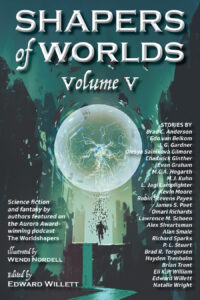
“Quid est Veritas?” originally appeared in the Shapers of Worlds Volume V, the final Kickstarted anthology featuring authors who were guests on my podcast–and me!
The story made Tangent Online’s 2025 recommended reading list, with two stars.
***
Quid est Veritas?
By Edward Willett
On the day Jonathan Timmins met his new assistant, the Truth did not change.
That was unusual—not unheard-of, but unusual enough that the day would have been memorable even if that event had not coincided with the even more unusual addition of a new person to the small staff he oversaw in the Central Office of the Instrumentality of Information.
The day’s unchanging Truth also meant he could greet his new assistant immediately upon her arrival, since he had literally nothing else to do. He knew nothing about her except her name and the fact that the Arbiters had chosen her for this position, but really, knowing that, what else did he need to know?
What he was not prepared for, as he entered the staff lounge where she was waiting, seated on a sleek white-leather couch, sipping coffee—black, he noted approvingly—and reading the Daily Truth on a small datapad, was how attractive she was. If someone had specifically designed her to appeal to him, they would have done nothing different, from her black hair drawn back into a practical ponytail to her slim build to her tight black jeans and loose blue blouse to the sparkle of her earrings and the matching sparkle of her dark-brown eyes.
In retrospect, perhaps that should have hinted at what was to come, but in the moment, he drank in her appearance for a long moment, as he might have a glass of sweet iced tea, before saying, “Miss Anders?”
She started, and then turned those mesmerizing eyes on him, smiled a smile that made his heart leap, and stood. “Mr. Timmins?”
“Yes,” he said. He reached out and shook her hand, and the feel of her fingers in his made his heart beat faster. “A pleasure to meet you, Miss Anders,” he continued, hoping his voice did not betray just how much of a pleasure it was. “Shall I show you around?”
“Please,” Miss Anders said. “And please, call me Sabrina.”
He smiled. “If you will call me Jon.” A bit presumptuous, perhaps—he was her boss, after all—but they were generally informal in the Instrumentality, being such a small group, and ultimately, who was there to be offended? The enforcers of such things as workplace propriety did not even know the Instrumentality existed.
Her smile widened. “Jon,” she said.
“Follow me, Sabrina,” he said, and led her into the small complex of offices hidden behind the biometrically secured door that was the Instrumentality’s only outward manifestation, tucked away in the sub-basement of the vast Brutalist edifice that also housed such monumentally boring government departments as the Department of Agricultural Implement Regulation and the Bureau of Desert Reclamation.
The tour did not take long, the “complex” consisting of precisely six offices, each containing a desk, a chair, a computer, and whatever personal decorations the inhabitant thereof had chosen to install. None of them had windows, of course, but high-resolution video screens did their best to mimic them, the choice of views reflective of the individual with each cubicle.
“The lounge, you have already seen,” Jon said as the brief tour ended in his office, twice the size of the others, but otherwise the same. His own video screens displayed a peaceful pine forest where nothing ever happened. He hadn’t bothered to introduce Sabrina to her coworkers. That would have been taken care of by the Arbiters, who almost certainly had also familiarized her with the layout of the offices, but there were still some human-interaction niceties to be observed, if one was to remain human at all: a challenge in this job for anyone, but particularly for Jon, due to the secret singularity of his existence.
He would have loved to have told Sabrina just what it was that made him unique—but, of course, he could tell no one. He would vanish, as other had, vanish so completely that no one would ever know he had lived. He could never breath a word of his personal truth to another soul, not even a soul housed in a body of such perfect pulchritude as Sabrina’s.
He showed her to her own cubicle, which had been empty for as long as he had been Prime—ten years now. The fact the Arbiters had chosen to fill it both puzzled him and mildly alarmed him. There had been no new Truth today, but did the Arbiters expect major updates to the Truth in the near future?
Even if they did, he didn’t understand how an extra person would help. It wasn’t like there was a huge workload for the four assistants he already had. They had nothing to do with propagating the Truth, of course; that fell solely to him. Their jobs were merely to monitor the Truth’s dissemination, watching for dead spots in the flow of data that indicated individuals who, for whatever reason, had not received it. AIs could and did do the same, but the laws that had established the Instrumentality and continued to regulate its activity were clear: a human had to oversee all AI activity, keeping an alert eye on the AI. An A-eye on the AI, Jon thought, as he always did.
“You’ve had the training input, I presume?” Jon said as Sabrina sat at her desk for the first time.
“Of course,” she replied, so quickly that he shot a quizzical glance at her, but she met his gaze guilelessly. “We’re here to keep an A-eye on the AI.”
He blinked at that. He’d never said that rather lame pun out loud. She’d thought of it herself. She really is perfect, he thought, and then pushed the thought away. “Right, then. I’ll leave you to it.”
He said it bravely, but in fact, he missed her the moment he was out the door.
* * *
Over the next three weeks, Sabrina seemed to settle in perfectly. She joked and laughed with her coworkers during coffee breaks. She spent the requisite number of hours at her desk monitoring Truth flow, and even flagged a couple of false positives that prevented individuals from being wrongly rounded up. Jon approved of that: he had no problem with the necessary work of the agents of Truth Enforcement, but he did not want innocents rounded up; who would?
No technology was perfect. Those whose faulty implants had failed only had to have them repaired or, at worst, replaced. Still, there was a backlog and, of course, it was a surgical procedure that entailed some risk and recovery time. While such individuals were being treated, they also, of course, had to be kept in solitary confinement. It all meant great disruption to their lives, both public and private. It had to be done, but it also had to be done fairly and only to those who truly needed it.
The only individuals who truly had to fear Truth Enforcement were those who whose brains, despite being provided with perfectly functioning implants, refused to be rewritten. They were, fortunately, vanishingly rare: far rarer than a day without a new Truth; rarer, even, than a day when Jon received a new assistant.
Perhaps that, too, should have been a warning.
* * *
It should not have happened, according to all the workplace regulations that applied throughout the federal government, but again, who would ever know?
It took three months but, in the end, there came a night when Jon and Sabrina, though they left separately, found each other in a bar an hour later, and three hours after that, found themselves in bed together, and seven hours after that, discovered they were still in bed together, and three hours after that, arrived at work—separately, of course.
Their relationship continued, discretely. Jon did not believe the others in the office had an inkling. They did not go out in public after that first night in that first bar; their time was spent in pleasurable solitude at Jon’s place. He suggested once that he come to Sabrina’s apartment, but she shook her head vigorously. “No,” she said. “I share with two other women. Far too risky.”
They were in bed as they often were, snuggled in post-coital afterglow, and he turned his head to her to smile. “Surely they’ve had men—or women—over.”
“No,” Sabrina said. “We have an agreement. That sort of thing—” her hand wandered, and he gasped a little, “—this sort of thing,” she went on, a bit of a purr in her voice, “is to be kept out of the apartment.”
Jon, having just lost all interest in whatever it was they had been talking about, never mentioned it again.
* * *
Six months after she began work at the Instrumentality, Jon learned the truth about Sabrina.
Perhaps, had he not been so besotted, he would have twigged earlier, but lovers—so he’d heard, having never really been one before—tended to overlook small imperfections in their significant others, and so he had discounted the occasional lapses, the times when she seemed to still believe a previous Truth instead of the day’s Truth, the instances that might have been a slip of the tongue: the use of a wrong pronoun here, the lack of appropriate deference to a newly exalted political figure there.
On the day he finally grasped the truth, however, the slip was so egregious it could not be overlooked.
Perhaps, too, he would have noticed sooner had there been more momentous Truths over their six months of mutual bliss. Instead, most were so minor they never came up in conversation: the tweaking of a historical narrative, the erasure of a disgraced mayor, the eradication of all references to a species of amphibian that had just gone extinct due to the destruction of its habitat by a mega-solar farm.
But on the morning of September 18 there was a snowfall, so early and accompanied by such cold weather that on the morning of September 21, after more typical autumnal weather had melted all traces of the unusual precipitation, the Truth went out to the population that no snowfall had occurred, early snowfalls having been eradicated as a possibility by an earlier Truth, and everyone promptly forgot about it.
Cognitive dissonance was the great enemy of the Truth, and had been since the government had decided to take advantage of the new technology of neural implants to deal with the problem of disinformation head-on, first decreeing that everyone must have an implant (in the interest of public health, the implants having been found to be useful in treating mental illness, which the population had been previously assured had reached epidemic proportions) and second, using those implants to begin placing within the minds of their citizens only those facts and opinions approved by the Arbiters, individuals carefully chosen from among the greatest and most progressive thinkers of the age.
Of course, a later Truth had erased the memory of half of the original Arbiters, after a bitter internal struggle over some Truth now forgotten—something to do with gender, Jon believed, though he had been a child at the time—and now, there were—and always had been—only three Arbiters.
It was the task of the Instrumentality of Information to ensure that the Truth, as determined by the Arbiters, was instilled in all citizens. The Information Act had eliminated political polarization; indeed, it had eliminated politics, since some twenty years ago, a Truth had been proclaimed that there was only one political party because all others had voluntarily disbanded when the Information Act was passed, having realized they were no longer needed now that governmental perfection had been achieved.
The same pattern had been followed in almost all the world. Those few countries that did not follow the example of the more enlightened nations remained sunk in squalor, struggling to survive, cut off from all contact with their betters and mired in internal squabbling and occasional wars. They laughably called themselves the Free World when, of course, their citizens were, in fact, enslaved by petty passions, their thoughts muddled and befogged by thick clouds of disinformation, always seeking the Truth—so they said—but never able to find it.
And yet, though he could never admit it to anyone, he identified with the poor Free World citizens—because, in a sense, he was one of them.
Jon was immune to the Truth.
Like everyone, he had received his implant at the age of eight. It hadn’t taken him long to realize he was different. His friends would come to school one morning and every one of them would believe something that, the day before, they had not: that a particular sports team had won a championship game when, in fact, as he remembered, they had lost it; that a new singer was someone that had all been passionate fans of for months when, in fact, he had never heard of her until that day.
He had always been a bit of a loner, and so had never revealed his confusion to any of his friends: instead, he simply pretended to believe whatever they all now believed. He had hidden his disability—knowing even then that if anyone found out, he would vanish as if he had never existed—so well that no one had ever learned of it; and to ensure that no one ever would, he had directed all of his educational years and his early years in government service toward the goal of becoming part of the Instrumentality of Information. Where better to hide his seditious sickness than in the heart of the organization it most threatened?
Twenty years ago, he was hired as one of the cubicle workers he now oversaw. Ten years ago, he had been appointed Prime after the previous Prime retired. For a decade, he had disseminated a new Truth more mornings than not with a simple click of his mouse, making sure before he clicked that he knew what was in the Truth so that he could continue to pretend he, too, had had his memories and beliefs altered by the implant in his head.
And so, when he passed Sabrina in the hall on the morning of September 21, after the Truth had been sent out, and she said, “I miss the snow,” he knew—and berated himself for not noticing sooner.
She went into her office. He had been headed to the lounge, but instead, he returned to his own desk, staring at his computer, displaying nothing now that the Truth had gone out but a shifting aurora of coloured lights. It was his duty to inform Truth Enforcement that he had identified someone who was Truth-immune. But how could he? Telling Truth Enforcement the truth about her could reveal his own dark truth, since it was his own immunity to the Truth that had made him immediately realize what her statement had meant. Otherwise, he might have just blinked at the apparent non sequitur and kept walking.
He was still dithering when there came a soft knock on his door. “Come in,” he said, then sucked in a sharp breath as Sabrina entered
She closed the door behind her. “May I sit down?”
He jerked a nod and waved at one of the two chairs on the other side of the desk. She lowered herself into one. She regarded him. He barely breathed. “I didn’t make a mistake,” she said after a long moment.
Careful. “I don’t know what you mean.”
“Yes, you do.” Sabrina took a careful look around the office, at his desk, and at the ceiling, then cocked an eyebrow at him.
It took him only a moment to realize she was asking if they were under surveillance. “No,” he said. “Not here.”
Sabrina nodded and leaned forward, though despite his assurance, when she spoke, she kept her voice low. “I didn’t make a mistake. I wanted you to know the truth about me as I know the truth about you. You are Truth-immune. So am I.”
His heart hammered in his chest. No one said such things out loud—no one sane, anyway. And though he had just told her there was no surveillance in his office, in truth—or Truth—how could he be certain?
“I don’t know what you’re—”
“Spare me,” Sabrina said. “There’s no time. I know the truth about you. I’ve known it since I arrived here—since I was sent here.”
“Sent?”
“There are more Truth-immune than you know. More, we hope, than the government knows. We have a way to identify Truth-immune, and over time, we have recruited many of them. We’re organized into small cells with little contact with each other so the organization cannot be rolled up if one cell is identified.
“We’ve developed a solution. We’ve had it for years. What we haven’t had was a way to make it work. Then we discovered you were one of us. And that’s why I’m here.”
“A solution to what?”
“To the Truth.”
His heart pounded. “What? How—”
She reached up and took from her left ear one of the sparkling earrings he had so admired when they first met. She held it out. “Take it.”
Not knowing what else to do, he did so.
“The stone is a data crystal,” Sabrina said. “Download the code it contains into your computer. Attach it to the Truth as part of your certification. It will overwrite the Truth. It will permanently deactivate the implants—all of them—and restore the memories suppressed by them. Everyone will know in an instant how they have been lied to and manipulated. Everyone will be free.”
Jon clenched his fist around the earring. “You’re insane! That would mean—chaos. Riots. We’d become like one of those pre-Truth hellholes—”
“They’re not hellholes,” Sabrina said. “They’re simply free. Like we were, before the implants. Before the government decided it would decide the Truth for everyone—the Truth that is really a lie.”
“Violence. Hatred. Polarization.”
“Innovation. Advancement. Free speech.”
His chest ached as he stared at her. “Was this all a lie?” he whispered. “What we’ve had together . . . was that always the plan?”
Sabrina hesitated. She bit her lip. “It began as a ruse. But it became the truth.”
“You just said the Truth is a lie.”
“The Truth you put into people’s heads is a lie,” Sabrian said. “But there is truth above and beyond the Truth. And my love for you . . . is that kind of truth.”
Something beeped. Sabrina looked at her smartwatch. “I have to go back to my office now,” she said. She stood, turned, went to the door, and then glanced back. “There is no truth in the Truth,” she said. “No pravda in Pravda, as the Soviets used to say. But there is still truth.”
She went out and closed the door behind her.
Jon was still staring at the earring in his hand when he heard a bang and shouting. He put the earring in his pocket as he got to his feet. He had taken only two steps when his door opened again, this time revealing a large man in the innocuous beige uniform of Truth Enforcement. “Director Timmins?” the man rumbled.
Jon’s mouth had gone dry. He nodded first, mostly to give himself time enough to swallow. “Yes,” he croaked. “What’s this about?”
“I’m afraid you’ve been infiltrated,” the man said. “By the Clear Eyes.”
The Clear Eyes. The organization that had fought against the Truth Laws, when he was just a teenager. Sabrina hadn’t used the name, but he remembered it. He also knew they had been expunged from memory by the Truth, and so he simply gave the agent the look of puzzlement he had perfected over the years. “Who?”
“Never mind,” the man said. “They had a plan to subvert the Truth, but we received a tip this morning from a patriot.” He held up something that sparkled: the twin of the earring in Jon’s pocket, which suddenly seemed red hot. “This stone is a data crystal your assistant Sabrina Anders intended to send out with the Truth. Who knows what damage it might have caused?”
“I’m shocked,” Jon said, both because he was, and because he felt he had to say something.
The agent glanced around the office. “Nice. Guess being the boss pays off.”
Jon didn’t know how to respond to that. “I’m glad you caught her,” he said instead.
“You should be,” the agent said. “Never mind the damage her little program might have done, as Prime, you would have been held responsible.”
Because the Arbiters never have to take responsibility for anything, Jon thought. “When you control the Truth, you are never held accountable.”
The expression was not his own: it had bubbled up from the mention of the Clear Eyes. It had been one of their sayings, before the Information Act: one of their core beliefs.
One of Sabrina’s core beliefs.
“I appreciate your service,” Jon said, years of prevarication slathering the lie with a sheen of sincerity.
The agent gave him one last, searching look. Jon met his gaze squarely. Truth Enforcement prided itself on its ability to read expressions; he remembered that, too, among the many things he should not have. Clearly his betrayed nothing: the agent nodded once, then “Thanks. Have a good rest of your day. We’ll probably have some questions later. Don’t leave town.”
He went out. Jon’s office door closed. The strange voices in the halls went silent. When he ventured out, none of the others said anything about what had happened. Their implants hadn’t reprogrammed them—they just knew better than to talk about it.
Jon went home early. His apartment seemed emptier than it ever had before, in his years of solitary living. He wondered where Sabrina was. He wondered if she was still alive.
Yes, he though. They’ll want to interrogate her.
That thought held little comfort. He didn’t think she’d betray him voluntarily.
That didn’t mean she wouldn’t betray him.
* * *
After a near-sleepless night, Jon went into the office early, well before he was expected to click the button that would send out the day’s Truth—technically totally unnecessary, required, like so much else in the Instrumentality, merely to pay lip service to the human-oversight provisions of the Information Act, though why the Arbiters hadn’t simply erased the existence of those provisions from everyone’s minds, Jon could not say. Some lingering sense of social responsibility perhaps; more likely, they just hadn’t gotten around to it. They must be very busy, deciding the Truth.
He sat at his desk, alone in the tiny complex of offices. He perused the day’s Truth. There were new Truths about various economic issues, new Truths about which racial groups were to be favoured in hiring, many others . . .
. . . and one Truth, buried deep in the matrix, proclaiming that there had never been a person named Sabrina Anders, and that all those who had known her would forget she had ever existed.
He stared at that line of text.
He thought about the last six months.
He thought about the last ten years.
He thought about all he knew but had pretended he did not.
He thought about all those around him knew that he knew to be false.
He thought about Truth, and he thought about truth.
But mostly, he thought about Sabrina, and what she had said to him, almost at the very end. “The Truth you put into people’s heads is a lie. But there is truth above and beyond the Truth. And my love for you . . . is that kind of truth.”
He took the earring from his pocket. He popped out the data crystal. He put it in the reader. He rested his finger on the mouse button, the button he had clicked for ten years to disseminate the Truth that this time would upload an implant-killing virus into the system.
Moved by some obscure impulse inspired by the history he remembered that few others did, he paused. A change in regime, he seemed to recall, was usually accompanied by ritual words of power.
He thought a moment, then smiled. “The Truth is dead,” he said, his voice ringing in the office though there was no one to hear it. “Long live the truth.”
He clicked.



2 comments
WOW! Great story! Futuristic only in the degree to which is it is currently possible and perhaps probable.
Thank you.
Author
Thanks! I’m glad you enjoyed it.