


Amazon.com | Amazon.ca | Shadowpaw Press
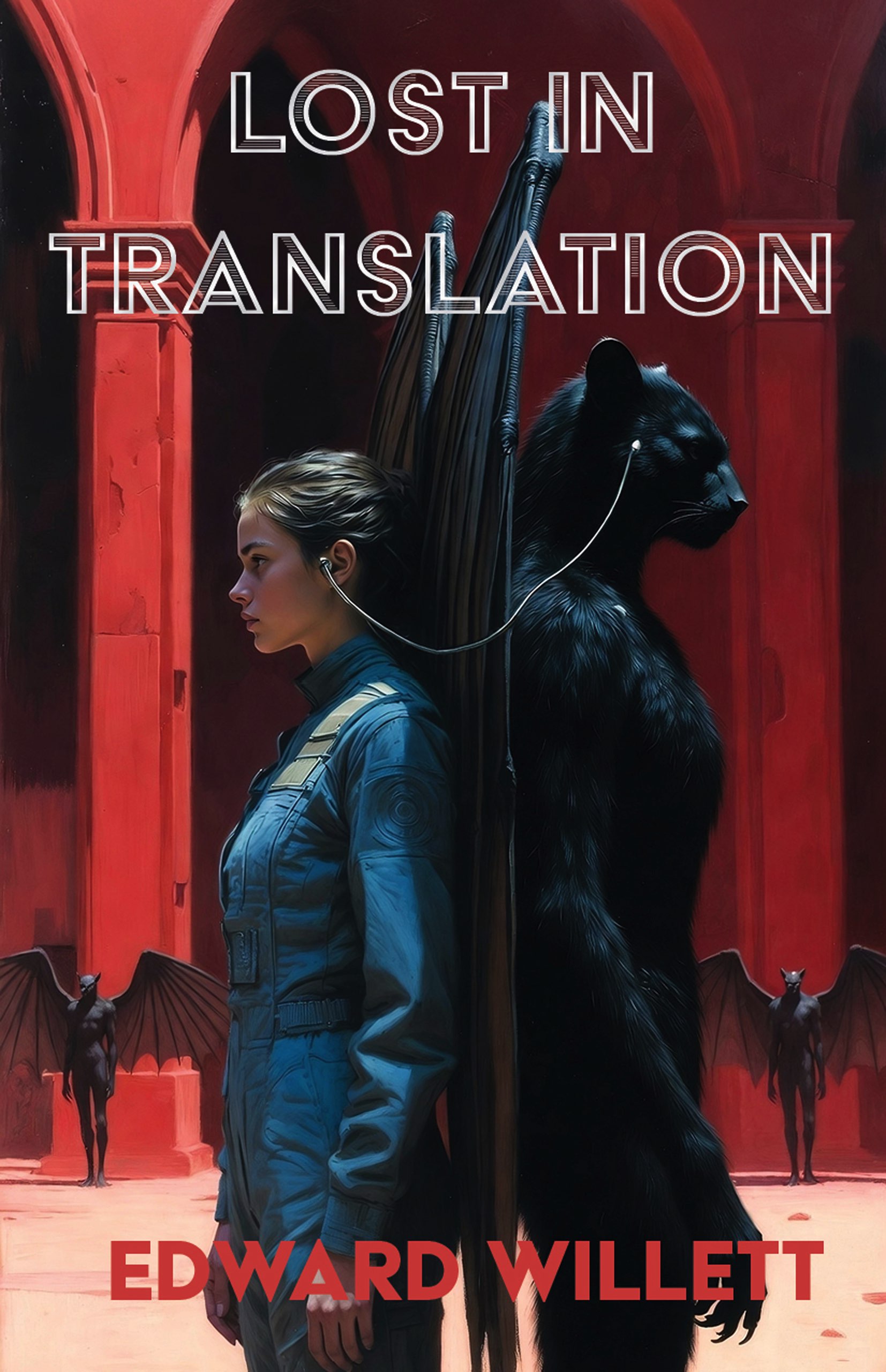
Prologue
Jarrikk watched the humans crossing the polished black basalt floor of the Great Hall of the Flock as closely as if they were prey, hearing their strange footsteps echoing back from the distant walls. Spidery red columns, studded with perches and platforms, soared to the haze-hidden roof, S’sinn clinging to them in dozens and hundreds. Jarrikk could feel his people’s hatred of the humans beating down like desert sun, hot enough to turn the bitterness in his own hearts into bloodfury were he to allow it.
His crippled left wing ached, ached as it had not since the day of his injury, the pain throbbing in the withered flight muscles in his shoulder and chest and into his left arm. Humans! The plague of his childhood, the cancer that had eaten away the best parts of his life, the poison that now threatened the Commonwealth itself. He had first seen the ugly, flightless, four-limbed creatures twenty years past. War had followed. He would gladly have gone another twenty without seeing them again, but the Translators’ Guild had called him to this duty.
These negotiations had almost not happened at all. Without Full Translation, they would be impossible. S’sinn Translators were few and far-flung among the Seven Races; at this time and this place, he was the only one available, though he had never Translated with humans before.
He wished that could have remained true, but his Oath bound him. He would do his duty.
If war came this time, it would not be his doing.
* * *
The giant hall whispered with the rustlings of the S’sinn, here stretching batlike wings, there yawning to display gleaming white fangs or grooming themselves with their ventral arms, but mostly just staring, staring with the blood-red eyes of a thousand nightmares.
The damp chill and near-choking scent of musk pervading the Hall of the Flock might have come from those same dark dreams, Kathryn Bircher thought, shivering in her sleeveless Translator’s uniform. As might the sense of foreboding that gripped her. For a moment, she envied Ambassador Matthews and his aides, cut off from the seething sea of alien emotion she’d begun to feel the moment she stepped out of the shuttle. She knew the other five races of the Commonwealth considered humans and S’sinn primitive, almost barbaric, barely free of their animal pasts. Maybe that was why she could read the aliens so clearly, with very little effort, as clearly as she could read Matthews himself, his cold, passionless soul a spire of ice among the smouldering red fires of the aliens’ hatred.
Or maybe it was because the last time she had been exposed to the raw emotions of the S’sinn, her world had shattered.
She stared ahead at the waiting S’sinn leaders on the small, circular dais, still impossibly far away. The fires of rage in this room could shatter a great deal more than just her world; they could shatter a thousand.
She wondered if anyone could stop them.
* * *
Jarrikk focused on the human Translator, sharpening his gaze to hunting mode. He could see every strand of her blonde hair, every tiny imperfection in her pale skin, could even count the stitches that held the triangle-within-a-circle-within-a-square symbol of the Translators’ Guild in place above the curve of her left breast. He raked his eyes over her figure from a distance of fifty spans, memorizing every claw’s breadth of her within the space of five of her steps. Within that time, he knew how she walked, how she breathed, which hand she favoured, and where her uniform chafed her. Within minutes, he would know her interior landscape just as perfectly.
He didn’t even notice his claws gouging splinters from the golden wood of the dais.
* * *
Feeling that she carried not only her small metal Translator’s case but also the weight of a thousand S’sinn, and the lead ball and chain of her own nightmares, Kathryn stumbled as she mounted the platform. Ambassador Matthews steadied her with a strong hand. It was all she could do to keep from flinching; she could shut out much of the hatred beating down on her from the S’sinn, but touch strengthened empathy a hundredfold, and for that moment of contact, his little candle of hatred burned brighter than all the red eyes of the S’sinn—and he held the fate of negotiations in his hands as much as she did.
She pulled free, took a deep breath, straightened, and looked around. The dais bore a black, glass-topped table and metal chairs for the humans and, for the S’sinn, the padded resting racks called shikks, which to Kathryn looked more like torture devices than comfortable body supports, even for creatures with two wings in addition to the normal complement of arms and legs, and bizarre musculature to match. Matthews and his aides sat at the table; a female S’sinn, already reclining on one of the shikks, watched them in silence. Three others stood just behind her.
Each S’sinn wore only a broad metal collar, marked with a sign. The female on the shikk, on whose red-gold collar a sapphire-studded lightning bolt slashed across a spiral of rubies, would be Akkanndikk, the Supreme Flight Leader. The other two, male and female, would be her Left Wing and Right Wing, her aides and bodyguards. On their copper collars, dull red stones picked out the spiral, minus the lightning bolt. As Matthews sat down, they spread their arms and their wings, revealing the insignia repeated in metallic red on the black, leathery membrane.
The fourth S’sinn also unfolded his arms and wings in greeting, but though his arms moved normally, only his right wing extended fully; the left opened only halfway, and Kathryn glimpsed lurid purple scars zigzagging across it. On his silver collar and on his one good wing gleamed a triangle inside a circle inside a square.
Translator.
Kathryn felt him trying to read her empathically, and blocked frantically, instinctively, though the effort made her head throb. By Guild etiquette, that was unforgivably rude, but she couldn’t help it. Facing the S’sinn Translator, all she could think of was the first time she’d seen a S’sinn this close, and the memory threatened to send her screaming from the room.
Yet now she had to get even closer. Now, she had to Link.
* * *
As the human blocked his polite probe, Jarrikk growled deep in his throat. How dare she! What it had cost him to make the effort, she could never know . . .
Except she would know, in a moment. His anger dimmed slightly, damped by curiosity. Why block the initial contact when the deeper contact was heartbeats away? Did she fear it as much as he? Was fear the sharp smell that mingled with the humans’ strange, salty stench?
Fear or not, the Link could not be avoided. They were sworn to Translate, and that meant they must Link.
It seemed the human recognized that fact as well as he; she stepped to the centre of the dais, set her case on the floor, opened it, and took out the injector, a small glass cylinder with an absurdly tiny needle. Is human skin really so thin? Jarrikk wondered. He stepped forward with his own case, removed the much larger metal injector, and, without giving himself time to think, drove it into his left arm.
As the warm tingling of the Programming spread through his blood, he looked at the human. She still held her tiny syringe in trembling hands, staring at it as though it might explode, and the sharp scent he took to be fear was strong in the thin film of moisture that had suddenly covered her skin; but then her strange blue eyes came up to meet his gaze, and with a jerky, ungraceful motion, she stabbed the little needle into her arm. The syringe still shook in her hand as she returned it to her case.
Jarrikk reached into his own case, took out the warm silvery cord of the Link, and touched it to the contact patch behind his right ear. He proffered the other end to the human, but she didn’t take it, staring instead at his polished black claws. Behind her, the dominant male, the Ambassador, stirred and muttered something, but the human Translator didn’t respond. Jarrikk wondered if, even now, she would refuse the Link, and felt shame at his half-born hope that she would; or, more accurately, shame at his lack of shame at the thought.
Confusion, he thought. Humans bring nothing but confusion. Confusion and pain.
But he had sworn the Translators’ Oath, and so he kept the Link extended: and, at last, the human took it, careful not to touch his clawed hand, careful to the last, though it seemed she, too, would uphold her Oath, and all her care would mean nothing momentarily.
For the last time, the human hesitated, staring at her end of the Link. Then, the Ambassador cleared his throat and said something, his voice deep and painfully harsh to Jarrikk’s ears.
The human Translator snapped something even harsher and louder in return, and firmly touched the cord to the patch under her own ear.
As human and S’sinn memories, terrors, and anger melded and fused, a great many things became clear.
Chapter One
The wind caressed the leathery membrane of Jarrikk’s wings and tickled the soft hair of his belly like his brood mother once did to soothe away nightmares. For a thousand heartbeats, he’d been holding his wings imperceptibly angled, spoiling the airflow ever-so-slightly. His chest and shoulder muscles ached with the effort, but he would have shrieked with excitement if it wouldn’t have ruined everything, because Kakkchiss and the others now flew thirty lengths ahead of him and had yet to realize that he lagged behind.
With relief, he drove toward the clouds with powerful strokes. This time, he had Kakkchiss. The youngflight leader would never know what hit him!
High enough. Jarrikk focused prey-sight on the sleek black hairs rippling over the powerful muscles in Kakkchiss’s back, folded his wings, and dived.
Kakkchiss flapped on, his attention apparently entirely on the forest below. “You wait,” he said to Llindarr, on his right. “Flight Leader Kitillikk will threaten to rip our wings off when we get back, but she’ll be glad to hear a clear-eyed report of what these aliens are doing, just the same. She’ll probably make us full-fanged Hunters on the spot, isn’t that right, Jarrikk?” And at the last possible instant, Kakkchiss sideslipped smoothly out of Jarrikk’s way. As Jarrikk hurtled through empty air, Kakkchiss’s laughter followed him down.
Claw-rot! Jarrikk snapped his wings open, grabbing air so suddenly he almost tumbled out of control. He righted himself but stayed put a good fifty lengths below Kakkchiss and the other four members of the youngflight, their good-natured abuse raining down on him. “Give it up, Jarrikk! Kakkchiss is leader to stay!” “Noisiest dive I ever heard!” “Hey, even those aliens could fly better than that!”
That stung, because the strange aliens who had just landed on their planet of Kikks’sarr—their planet, Jarrikk thought, with a familiar sense of outrage that the aliens had dared—flew only with noisy motors and stiff artificial wings. “There’s one now!” Jarrikk shouted suddenly, pointing down, and had the satisfaction of seeing all but Kakkchiss spill air, proving pretty conclusively, Jarrikk thought, that they weren’t nearly as unconcerned as they claimed to be about this flouting of Flight Leader Kitillikk’s command to roost until she decided how and when to contact the aliens.
Not that they planned to contact them, Jarrikk hastily reminded himself; just spy on them.
Kakkchiss hadn’t put a wingtip out of place. He really is good, Jarrikk admitted to himself. An excellent leader. But I could be better.
Still, Kakkchiss caught his eye and clawed the air with his arms in a gesture of respect, and Jarrikk felt a little better. One thing about Kakkchiss, he never begrudged Jarrikk’s attempts to dethrone him, and Jarrikk thought that if—no, when—he finally succeeded in catching Kakkchiss off-guard, Kakkchiss would accept it—and then, of course, immediately set about getting the leadership back.
Well, it was no good sulking down here all day. They must still be at least two thousand beats from the aliens’ landing place. Jarrikk strengthened his wingstrokes and started to climb.
Something flashed, blindingly white. Jarrikk blinked. Lightning? Out of a clear sky? “Kakkchiss, did you—” he started, then stopped, gaping.
Kakkchiss’s wings, those smoothly powerful tools that never stumbled in even the roughest air, fluttered uselessly, spasming like they had suddenly developed minds of their own; and then they stopped altogether, and Kakkchiss dropped from the sky.
He plummeted down toward Jarrikk, and for a moment Jarrikk thought he’d been wrong and Kakkchiss intended to take revenge; but as Jarrikk spilled air and swung out of the way, he glimpsed the gaping, blackened hole in Kakkchiss’s chest. Trailing a thin stream of smoke and blood and the smell of burned meat, the youngflight leader hurtled a thousand lengths into the forest below, striking the treetops with a terrible breaking sound that carried clearly to Jarrikk’s horrified ears.
Jarrikk’s own wings suddenly didn’t want to work anymore. He circled down toward the scar in the forest canopy, while above him the other younglings whirled, shouting in confusion. “Jarrikk, what—” Yvenndrill called, then the strange bright flash came again and the call became a choking shriek that dopplered toward Jarrikk.
Jarrikk tore his eyes from the place where Kakkchiss had fallen just in time to see Yvenndrill spinning helplessly down, blood streaming behind him, his agonized shrilling ending abruptly as the sharp splintering branches of the trees broke his fall and his back. His severed wing, still twitching, fluttered down seconds later.
Stunned, almost numb, Jarrikk spiralled down to the trees and clung to a high branch, staring back up at the sky, where Llindarr and little Illissikk, the youngest, still circled in terror and confusion. The light flashed again, and this time Jarrikk saw an energy beam split the air between the two bewildered younglings and realized at last that someone was shooting at them. “Dive!” Jarrikk screamed at them, just as they reached the same conclusion and headed for the trees.
Llindarr had only descended a few lengths when the beam flashed again. For a moment, Jarrikk thought it had missed, because Llindarr’s dive still seemed in control—but he never pulled up, and the upthrust tip of a forest giant impaled him in a shocking spray of blood.
Illissikk almost made it: might have made it, if he hadn’t tried, at the last minute, to pull up low over the forest and join Jarrikk. The beam flashed one last time, and Illissikk’s headless body slammed into the clearing below Jarrikk’s perch so hard it shook the tree he clung to. A thin pattern of deep scarlet drops spattered the dark brown fur of his chest.
Jarrikk wanted to shriek himself, then, wanted to throw himself in blind panic into the sky, but fought down the instinctive urge to flee with reason—and rage. If he left cover, he would die, too, cut in two by the beam, and the Flight Leader might never know what had happened. But if he stayed, he would see the hunters who had used this horrible weapon come collect their “trophies.” And then he could tell the Flight Leader with absolute conviction what he already knew in his hearts: that the strange aliens who had landed on their planet were bloody-handed murderers. And then, it will be the S’sinn’s turn to hunt!
And so he waited, and watched, a hundred heartbeats, and a hundred more, and a thousand after that, absolutely still, absolutely silent, until at last, as he had known they must, the murderers emerged.
There were three of them, hideous, near-hairless four-limbed monsters, like wingless, bald S’sinn. Two were much larger than the other, whose face had the unformed look of a youngling. They wore brightly coloured coverings like the S’sinn sometimes wore on holy days, and both carried black, evil-looking tubes with knobby handles. The murder weapons, Jarrikk thought. It was all he could do to keep from diving on them then and there and tearing out their ugly throats.
The youngling seemed agitated about something, pulling on the upper limb of one of the adults, his voice shrill and painfully loud, but the adult pushed him away and said something in a deeper, harsher voice.
As the youngling alien watched with wide eyes, the adults knelt beside Illissikk’s corpse. Then—Jarrikk’s claws dug deep into the branch—one of them drew out a glittering knife and began cutting at the dead youngling, skinning him as though he were a jarrbukk!
Worse followed. One of the large aliens went into the forest and emerged moments later carrying something wrapped in giant leaves. With a flourish, he swept them aside, revealing Illissikk’s head. A branch or rock had ripped out his left eye, but his right remained, wide with his final terror.
The aliens seemed to take forever about their grisly business, but Jarrikk held down his impatience with the same cold calculation he had already applied to his revenge. There would be revenge, and soon enough, but first, he must bear the tale back to the colony. First, Flight Leader Kitillikk must know. And then—
—then, it would be the aliens’ turn to feel the cut of knives and beams in their hairless, pale skins.
At last, the monsters finished and disappeared into the forest again, leaving behind a pile of bloody meat indistinguishable from any dead beast. Illissikk had vanished as if he’d never existed, reduced to less than nothing by the aliens’ cold knives. They had moved on, no doubt to do the same to Kakkchiss and the others; and now, at last, Jarrikk moved, too, unfurling stiff wings and sweeping silently away into the gathering twilight, low to the treetops, where he knew he would be all but invisible.
He would not allow himself grief; he clung to his need to report to the Flight Leader as he might have clung to a slim green branch in a thunderstorm, refusing room to the other black thoughts that tried to shoulder in to share it. Thirst and hunger soon joined the throng, but he refused them a place to land, as well. Cold rage and the hope of hot revenge were all he needed to sustain himself this day.
They’d been a half-day’s flight from the colony when the aliens attacked; deep night’s bitterly cold black wings covered the world when Jarrikk, with ever-slower wingbeats, finally began flapping wearily up toward the high mountain caves into which the S’sinn had withdrawn with the coming of the aliens. They had abandoned their airy treetop structures with a prudence Jarrikk had thought foolish at the time. No longer.
A dark shape slashed down to meet him, briefly silhouetted against the star-lit glimmer of snow-capped peaks before swinging into position wingtip-to-wingtip on his right. “Jarrikk?”
“Ukkarr,” Jarrikk rasped, with barely enough breath to talk. “Must see—Flight Leader.”
“So you shall, since the Flight Leader left standing orders to bring you younglings before her the instant you returned. Where are the others?”
“Dead.”
Ukkarr’s steady wingbeats stuttered. “Dead? How—”
Jarrikk concentrated on keeping his own wings beating. His story was for the Flight Leader first, not for her lieutenant. Just a few more beats . . .
Ukkarr didn’t ask again. Silent, he climbed with Jarrikk, guiding him away from the cave complex’s main entrance to a smaller, isolated cavern higher up the slope. “Wait here,” Ukkarr commanded, and plunged back into the night.
Wings still at last, Jarrikk slumped in the cold dark, chest and back ablaze with pain. He pressed the heels of his hands hard against his eyes, then slowly massaged his wing muscles. Thank the Hunter of Worlds that Ukkarr had thought to bring him here first. He couldn’t face their brood mother—not yet. What if she had seen him and asked about the others? He couldn’t lie to her. And the bloodparents . . .
Alone, no longer able to concentrate solely on the act of flying, the magnitude of what had happened threatened to overwhelm him. He folded his wings flat against his back and crouched on the cold stone floor. Wind whispered across the opening to the cavern, a soft, keening sound like a youngling just taken from its bloodmother, before the brood mother came to nurse and comfort it: but this night, Jarrikk knew, no comfort would come at all.
* * *
Flight Leader Kitillikk rested on a shikk outside her dwelling caves, overlooking the large central chamber that had served as their Flock Hall since the arrival of the aliens on Kikks’sarr drove them underground. Blood-red and smoky from a thousand torches and fires, it seemed a primeval place, like the legendary hot, hollow centre of the home world of S’sinndikk, where the Hunter of Worlds was said to dwell when not soaring through the universe on space-black, star-studded wings.
Or so the priest who had just left her had described it, but Kitillikk was of a more prosaic turn of mind. To her, it looked like a prison—a prison they had been forced into by the alien invaders. Her lips drew back in an involuntary snarl. The priest had all but ordered her to attack and drive the aliens back into space—had almost accused her of cowardice. But the priest didn’t have to answer to Supreme Flight Leader Akkanndikk back on S’sinndikk, who had given unequivocal orders: No attack unless attacked. To strike first would contradict the First Principles of the Commonwealth.
Kitillikk had her own opinions about the Commonwealth, opinions she intended to one day make S’sinn policy, when she became Supreme Flight Leader. But achieving that goal meant first succeeding at her current task of leading the colonization of Kikks’sarr, and that meant following orders. No attack unless attacked.
Just give her an excuse, though . . .
Ukkarr soared across the cavern and settled beside her. “Excuse my intrusion, Flight Leader, but you asked to be informed immediately upon the return of the youngflight that sneaked away to spy on the aliens.”
The youngflight that thought it had sneaked away. Kitillikk had known all about the younglings’ “secret mission”—she’d have had Ukkarr’s head if she hadn’t—but had chosen to let them go. She could use whatever information they brought back, however garbled the report. “They’re back, then.”
“Only one of them, Flight Leader. Jarrikk. He says the others are dead.”
Kitillikk turned and stared at him, then grinned savagely, showing all her teeth. “At last!”
Ukkarr led her to the cave where he had wisely stashed the youngling out of sight. Jarrikk slumped motionless inside, so that for a moment she thought him dead, too; but he jerked up when they entered and unfurled his wings in salute. Kitillikk motioned him to relax. He folded his wings, but every other muscle in his sleek young body remained tense.
Ukkarr drew a lightstick out of the Hunter’s pouch he always carried and cracked it against the floor. A cold blue light filled the cave and illuminated the snowflakes beginning to fall outside its mouth. “Tell me what happened, Jarrikk,” Kitillikk said.
The youngling told her, his voice high and strained, but admirably under control, considering what had happened. She remembered her own youngflight; they had lived for each other, would have died for each other. Had she lost her sisters as he had lost his brothers . . .
He has strength, she thought. Great strength.
When he finished his story, she turned to Ukkarr. The aliens had given her her opportunity; even the Supreme Flight Leader could not fault her now, and her name would echo in every Flight of the S’sinn after this. “Summon and arm the Hunters.”
“Yes, Flight Leader!” Ukkarr spread and snapped his wings in salute, then leaped into the snowy night.
Kitillikk looked back at the youngling. “Can you tell your story again, Jarrikk? Can you tell it to the Hunters?”
“I can. I will.”
“Then come with me.”
* * *
A thousand beats later, she stood overlooking the Flock Hall once more, Jarrikk beside her. More than a hundred Hunters now filled the red-lit space, clinging to every possible roost, and this night, the arms they bore weren’t the knives and spears and bows they used on game, but slim, black S’sinn-high rods: firelances. The weapons of war, not of the Hunt. “Tell them,” Kitillikk ordered Jarrikk.
He repeated his story, his voice going hoarse by the end of it, and her hearts beat faster at the shrieking roar that answered his tale. Her claws gouged the stone beneath her feet. An alien flung from her roost into the cavern at that moment would not have reached the floor before being torn to bloody shreds. She wished she had one with which to prove it.
“We waited, and hid, to see what kind of creatures these are,” she cried to the Hunters. “Now we know—they are murderers, savages, child-killers! Kikks’sarr is ours! Let us take it back!”
The second, greater roar of the Hunters filled her with the wild, fiery elation she felt only when fighting or mating. She spread her wings and arms again for silence. “We know where they camp! We can be there by dawn. By the time the sun sets again, let there be no aliens left alive on our planet!”
This time, the roar went on and on as the Hunters rose and swirled around and around the Flock Hall, then swooped out through the short tunnel leading to the surface and burst into the snow-filled sky. Kitillikk spread her wings to follow, but the youngling Jarrikk touched her wing and said, “Let me go with you!”
Annoyed, anxious to join the flight, Kitillikk snapped, “You are not a Hunter,” and spread her wings again.
But the youngling didn’t withdraw. “They were my brothers. They were my flightmates.” His voice grew hard and desperate. “I want—I have to see the creatures who killed them die. I have to.”
Admirable. Kitillikk considered. “I cannot arm you.”
“I know.”
“It is a long flight. One you have already made twice.”
“I know.”
“We cannot wait for you.”
“You won’t have to.”
He’s tough, Kitillikk thought. Or thinks he is. Good. “Very well. But you are not to take part in the attack. You will only watch. Understood?”
“Understood!” With his own shrill shriek of defiance and bloodjoy, the youngling spread his wings and flapped away.
Kitillikk flew after him thoughtfully. It would be good to cultivate a young male with such loyalty and fire. A personal bodyguard and aide of unquestioned loyalty—all Flight Leaders needed such. The Supreme Flight Leader had two, black as night, the Left Wing and the Right Wing. Kitillikk had Ukkarr, of course, but a second would not go amiss. A fine-looking, strong young male.
She grinned as she flew after Jarrikk. Oh, yes, he had to be male.
* * *
Jarrikk hurled himself into the night on wings made strong by his thirst for revenge, but that thirst could only take him so far. Within a thousand beats, his wings felt like lead and his lungs as full of fire as his blood had been, except this fire slowed him as much as the other had filled him with energy. He began to lag behind the Hunters. No one waited; he didn’t expect them to. The strong owed it to themselves and to the Flock to fly as hard and fast as they could. The weak must keep up the best they could, or silently turn back. Fly or die, the Hunters said. Fly or die.
Jarrikk kept flying.
When dawn broke, Jarrikk saw the alien camp ahead of him, marked by the glittering silver egg-shape of their ship, surprisingly small compared to the huge black sphere that had brought the S’sinn to Kikks’sarr. A half-dozen tendrils of smoke twisted lazily skyward in the still morning air, proof that at least some of the aliens were watchful. Jarrikk dropped to treetop level, then below, swooping through green-pillared corridors with his wingtips brushing leaves. He looked for Hunters with every beat, but saw and heard nothing—right up to the moment when something swatted him from behind and sent him tumbling ungracefully to the ground. “Find a roost and stay there!” Ukkarr growled, then somehow disappeared into the forest again.
More cautiously, Jarrikk worked his way from tree to tree until he had a clear view of the camp, which consisted of two prefabricated plastic shelters, a dozen brightly coloured tents—and a drying rack on which were stretched at least twenty pelts of various animals.
Three of those pelts Jarrikk recognized very well indeed. He gripped the branch so tightly he felt it split in his claws.
And then, with no audible signal at all, the Hunters dropped from the trees.
Black as night against the bright green, blue and yellow tents, they swept in a hundred-strong flock across the camp and back, firelances lacing the ground below with blood-red beams. Tents blossomed into orange flame that brought aliens naked and screaming into the light, hair ablaze, skin blackened, only to be cut in two by the next wave of Hunters. A half-dozen aliens close to the ship made it inside, including, Jarrikk saw with fury, the small one he had seen with the adults who killed his brothers, but others had time for only one startled look, time to open their mouths wide, before the beams found them and sliced them apart.
Jarrikk saw one of the two aliens who had killed his brothers running for the illusory safety of the prefabricated buildings, before beams set the buildings alight even more spectacularly than the tents. He half-unfurled his wings, prey-sight focused on the base of the male’s stubby neck, ready to fly after him himself, promise or no promise, when a beam slashed at the alien’s legs and he went down, blood spurting from half-cauterized stumps that ended where his knees had been. The alien tried to crawl away, but the next beam touched his head, which exploded into red steam and bits of charred flesh and bone. His torso bizarrely crawled another half-length on its own before falling forward, limbs twitching once or twice, and finally lying still.
Jarrikk’s lip curled in an involuntarily snarl. He only wished he’d fired the lance himself.
In two passes, the Hunters utterly destroyed the camp and every alien in it; but with an ear-hurting whine, the silver ship came to life, rising into the air, its lifters sending the smoke of the burning camp twisting and dancing across the carnage. One Hunter, more brave than wise, dived toward the ship, beam reaching out to caress the silvery skin, but that alloy was far tougher than the plastic of the prefabs or the fabric of the tents, and the lance didn’t even mark it. Other Hunters followed the first, but suddenly the ship’s whine turned to fang-rattling thunder, white flame exploded underneath it, and it rocketed into the sky, vanishing in a matter of seconds. In its fiery wake, the Hunter who had first attacked it fluttered to the ground like a burning leaf.
We won, Jarrikk thought fiercely. It’s over!
Two days later, when the first S’sinn warships arrived and the fortification of Kikks’sarr began, he knew he’d been wrong.
It wasn’t over at all.
It was just beginning.
Chapter Two
Katy pushed the mashed potatoes on her plate up and up into a shape like Mount O’Bagnon, framed in the dining room window just across the table from her. Then she began picking up her peas one at a time and sticking them into the potato-mountain, pretending they were the dekla trees that covered the real mountain, although they were entirely the wrong shape and not even close to the right colour. She pretended really hard that they were the right shape and colour, because pretending really hard helped her not to feel how worried and scared her parents were. When they were scared, she got scared, and she didn’t like being scared.
Pretending really hard sometimes helped her not to hear them when they argued, either, but they were right there at the table with her, and she couldn’t help hearing, even though she pretended Mount O’Bagnon suddenly turned into a volcano and all the dekla trees got covered in the thick brown lava she poured from the gravy pitcher.
“I can’t believe you’re letting them go ahead with this carnival,” Mama said, her voice all tight and strange. “After the news from New Atlanta? My God, Mike, just before we left Earth, the Sootangs said they were planning to emigrate to New Atlanta. They could be dead!”
“They could have been dead since the day we left Earth,” Daddy said. His voice stayed really calm and low, but it didn’t fool Katy; she could feel his worry just as strongly as Mama’s. She decided the peas didn’t look anything like dekla trees and had to be punished. One by one, she started squashing them.
“You know what I mean. Mike, we’re at war!”
“Earth is at war. We’re a thousand light-years from Earth. We’ve got nothing anyone would want.”
“We don’t know what these monsters want. We don’t even know why they attacked the colony on Petra to begin with!”
“They’re still intelligent creatures. They won’t attack a place just to be attacking. Luckystrike has no strategic value. We’re just a farming planet.”
“What strategic value did New Atlanta have? They killed a quarter of the people in the colony, Mike! Over three thousand dead!”
Daddy took a deep breath, and Katy could feel a little bit of anger inside all his worry. She squashed another pea, lining it up carefully under the middle two tines of her fork, then pressing down little by little until the green skin burst and the inside gushed out. It made her think of squashing the little green worms that kept trying to eat their garden, and she giggled, thinking how shocked Mama would be if she said that out loud. Daddy glanced at her. “That’s still no reason to cancel the carnival. You know how Katy’s been looking forward to it. Not having the carnival won’t make us any safer.”
“It just doesn’t feel right. Having fun when all those people—”
Daddy reached over and squeezed Mama’s hand, his anger receding and the undercurrent of love Katy could always feel between them welling up. “How’s this, then: we’ll have the carnival, and we’ll all go, just like we planned, but we’ll try really hard not to enjoy ourselves.”
Just for a minute, Mama got a little angry, and Katy stopped squishing her peas and looked up. Sometimes when they both got angry together, they started shouting, and she wanted to be ready to run up to her room, where she couldn’t feel their anger quite so much. But then Mama’s anger faded away and amusement replaced it, and Katy relaxed. No fight this time!
“It’s a deal,” Mama said. “But Mike, what if they do come here?”
“We’ve set up shelters, just like Earth told us to. If we get enough warning, they won’t be able to do anything but burn some buildings.”
“And crops, and livestock, and . . . how would we survive the winter?”
“Earth would send relief.” Daddy slid his hand under Mama’s and squeezed it. “It’s not going to happen.”
“I hope not,” Mama said.
Daddy smiled. “You have the governor’s word on it.”
Mama smiled back, and Katy smiled, too, turned her fork over, and ate her squashed peas.
* * *
Landing Day, four days later, dawned bright and clear, and Katy bounced out of bed the minute the sunshine touched her face, put on her best play-dress and sun-hat, and was downstairs for breakfast almost before Mama started making it. Mama wore blue shorts and a sleeveless white top, and Katy thought how pretty she looked with her sun-freckled skin and long red hair. She turned and smiled at Katy and said, “Happy Landing Day, Katy!”
Katy bounced up onto the green-topped stool behind the breakfast counter. “Happy Landing Day, Mama!”
Mama frowned. “You know, seeing you makes me think I’m forgetting something important. But I can’t think what . . .”
Katy giggled.
“I know!”
Katy waited expectantly.
“I forgot to salt the eggs!” Mama turned around and sprinkled a little salt onto the scrambled eggs in her skillet, and Katy laughed out loud. “But you know,” Mama said, putting the salt away in the cupboard, “I’m sure there’s something else . . .”
Daddy came in from the dining room and scooped Katy out of the chair and swung her around. “Happy Birthday, kittenkid!”
Katy squealed with pure joy, and then laughed again when Mama said, “Birthday? No, I don’t think that was it . . .” But then she turned around, too, as Daddy set Katy down, and gave her a big hug. “Happy Birthday, Katy.”
Katy jumped back up on the stool and bounced up and down, barely able to contain her excitement. Six years old, and Landing Day, too, and that meant they were going to the carnival, and somewhere there had to be a present for her, she couldn’t know exactly what, of course, but the only thing she really, really wanted was a synthibear. Misty Pendergrass had a synthidog, but a synthibear was better because it could walk on two legs and use its front paws to hold things. You could have a tea party with a synthibear, and all you could do with a dumb old synthidog was play fetch, but every time Katy played with Misty, she could feel how Misty thought she was so special because she had a synthidog, and Katy didn’t. Katy thought she’d really enjoy the new feeling she’d get from Misty the next time they played together if she had a synthibear.
But that made her feel a little bad, because she didn’t really like unhappy feelings from anyone, even Misty. And maybe it wasn’t really fair, because Misty never said anything out loud about her being special because she had a synthidog, and Katy had recently realized that because most people couldn’t feel what other people were feeling, they figured she couldn’t, either, so if Misty hadn’t actually said anything out loud, then maybe . . . maybe . . .
Mama set a plate of steaming eggs in front of her, and a slice of toast smothered in big, sticky, gooey, blue gobs of muffleberry jam, and Katy quit trying to figure out Misty and started eating.
“Weather should be clear all day, SatCom says,” Daddy said, coming back to the table from the comm unit. “And the carnival people arrived in orbit right on schedule yesterday and landed before nightfall. Everything’s set.” He winked at Mama, and Katy knew he was keeping a secret of some kind, not from Mama but from her, but that was all right. Birthday secrets were almost always good secrets.
Half an hour later, they set off down the grass-covered street toward the Landing Field, turned into a carnival ground “For One Day Only!” as the posters that had appeared everywhere in Luckystrike weeks before proclaimed. Katy loved those posters; she ran ahead of her parents to look at the one on the side of the two-story red-brick building where Daddy worked. A big smiling clown juggled Ferris wheels and danglepods and grav-ups and other exciting rides in the centre of the poster, while down at the bottom, young couples laughed while they threw balls at bottles or ate zipmud or rode into the Tunnel of Love, but the one thing Katy always looked for was the synthibear that sat on the shelf in one of the game booths in the background. She touched her finger to her lips, then reached out and touched the synthibear. “Mine,” she whispered. “I wish, I wish, I wish . . .”
“Really, Mike, letting them put a poster on the Capitol!” Just for a minute, Katy thought Mama was really mad, but then she felt the laughter underneath the words and knew Mama was joking, and she could tell Daddy knew it too, so she touched the bear one more time for luck and scampered back to her parents.
Daddy ruffled her hair. “Shocking, isn’t it, defacing such a classic structure?” He laughed. “Some day, we’ll have a real Capitol building—and a real governor, too.”
Mama put her arm around his waist and snuggled up to him. “I like the one we’ve got.”
Katy copied her. “So do I, Daddy!”
“Well, we’ll see what the colony thinks at election time. But that’s nothing I’m going to worry about now.” He scooped Katy up and put her on his shoulders. “Now, it’s carnival time!”
“Wheeeeee!” Katy squealed, and clapped her hands as they headed down the street, and then, they turned the corner, and there was the Landing Field, all the rides the poster had promised and more rising out of the middle of it like a little brightly-coloured city all its own. Early as it was, laughter and music and the smell of popcorn spilled out of the carnival, and Katy felt Mama and Daddy’s worry slip even further under the surface, and that made her feel even happier. “Fun!” she yelled, and patted Daddy’s head. “Let’s go have fun!”
“Your wish is my command!” said Daddy, and into the magical city they went.
The day passed in a blur of rides and zipmud and hot dogs and cotton candy and smoking iceys and acrobats and clowns, and only once did the worries come back to Mama and Daddy, when a tall, skinny man with a crooked nose and scraggly black beard came up to them while they waited for their turn in the bumper cars. “Governor Bircher. A word with you, if I may.”
Katy instantly felt Daddy go all tight inside, and she pouted. This was her day, her day and her parents’. Why was this stick-man trying to spoil it? She could feel him, all prickles and indignations and puffery, and she folded her arms and pointedly turned her back on him, staring into the dim interior of the bumper-car arena, where the red and green and silver cars floated and bobbed and bounced into and off of each other and the walls and the floor and the ceiling like a box full of balloons. Was that Misty Pendergrass over there in the silver car . . .?
“We’d like to ask you yet again to—”
“We?” Daddy interrupted.
“The Luckystrike Concerned Citizens’ Coalition, Governor Bircher.” The man radiated disapproval. Katy inched away from him, but it didn’t help. “As you well know.”
“Ah, yes, the L-Triple-C. And which of your many requests are you reiterating this time, Al?”
“The most urgent, Governor Bircher. Surely—”
“They’re all urgent, or so you would have me believe when you bring them up at great length in the Assembly.”
“In view of the news from New Atlanta, Governor, the LCCC has put aside its more parochial concerns for the good of the greater all. We have collected more than two hundred names on a petition insisting that Luckystrike formally declare its neutrality in the Earth conflict with—”
Katy felt her father’s rising disgust, but it was her mother who broke in suddenly with, “Does this mean you want to secede from the human race, Mr. Bastion?”
Bastion’s confusion momentarily overwhelmed everything else. “I don’t see—”
“What my wife is suggesting, Al,” said Katy’s father, “is that the only way you could remain neutral in this conflict would be to change species, because that seems to be the only thing these aliens have against us—the fact that we’re not them.”
“They are rational creatures whom we must have offended in some way,” Bastion spluttered. “They will not attack us if we clearly disassociate ourselves from the rapine policies of Earth Planetary Survey and Development, who—”
“Who built this colony and recruited you and your fellow concerned citizens,” Katy’s father said, his anger becoming hot enough that she was glad it wasn’t aimed at her. “If you consider their policies so misguided, perhaps you should ease your conscience completely and return to Earth. I would be glad to sign the necessary transportation orders.”
Bastion blinked. “Return to Earth? In the middle of a war? I’ll do no such thing.”
“Good. I’m glad that’s settled. Now, if you’ll excuse us, I believe it’s our turn at the bumper cars.” Katy’s father turned his back on Bastion, took his wife’s and Katy’s hands, and marched them into the arena, where the previous crowd of drivers was just disembarking on shaky legs from the cars, which had now all settled to the shiny black floor.
“Doesn’t he care about New Atlanta?” Katy’s mother whispered furiously to her father as they crossed that floor. Katy tugged impatiently at her father’s hand, hoping that if she got the two of them into cars and having fun again, the black cloud the stick-man had wrapped them in would lift. “Or the rest of the people who have died? Declare neutrality? It’s us or them! What kind of neutrality can there be in that?”
“The only people Al Bastion cares about are himself and his like-minded friends,” Katy’s father growled. “I imagine he’d much prefer that those of us outside the L-Triple-C simply vacate the premises and leave Luckystrike to them. Then they’d build a nice little insular ant colony and live—if you could call it that—happily ever after.” He took a deep breath, and his mood lightened a little bit. “But come on, forget about him. This is Katy’s day. We’re here to have fun, remember?”
Her mother patted Katy’s head in an absentminded fashion. Katy stared up at her and frowned. Mama had never done that before! She hoped she didn’t do it again, either.
The bumper cars were suitably bumpy, and as they all staggered out of the arena again after their ten minutes were over, Katy’s parents seemed to have forgotten most of their worries. A couple of more rides and a zipmud cone apiece took care of the rest of them.
They stopped at one of the game booths that lined the temporary streets of the magic carnival city, and Katy’s father smiled at her and at her mother, said, “Wait here!” and went to talk to the man running the booth. Katy busied herself with her cone, and just as she finished up the last sweet, crunchy bite, her father came back. “We’re up!” he said to Katy. He boosted her onto a stool behind the counter of the booth, and put a little laser pistol in her hands, then pointed at the holograms of bats and dragons and goblins and dinosaurs flying or walking or marching through the fog-filled darkened space beyond, and said, “Go on, kittenkid! See how many you can hit!”
Katy nodded happily and started firing the laser pistol through the fog, and though it seemed to her she wasn’t hitting very many holograms—maybe none at all—a light kept flashing and bells and sirens kept going off, and when her time ran out the man in the booth shouted, “What shooting! What an eye! We have a winner, ladies and gentlemen! A big, big winner!”
Katy turned around to see that a crowd had gathered outside the booth, and they all laughed and applauded as the booth man ducked behind the hologram chamber and came out with—
Katy squealed. “Is it really mine?”
“It really is! You won it fair and square, kid! Fair and square!” He set it down in front of her.
Katy stared at it. “A synthibear,” she breathed. “A really, really, truly synthibear. For me!” She hugged the bear hard, and suddenly it wriggled to life in her grasp.
“Hello, what’s your name?” it said cheerfully. “What’s your name?
“Katy!” Katy said. “My name’s Katy! What’s yours?”
“What would you like it to be, Katy?”
Katy had figured that out a long time ago. “Your first name’s just Bear,” she said, “and your last name is Bircher, just like mine. You’re Bear Bircher!”
“Bear Bircher,” the bear repeated. “Okay, Katy! Do you want to play now, Katy?”
“Time to go home, Katy,” her father said. “Then you can play with Bear until bedtime.”
“All right.” Katy studied Bear doubtfully. “I don’t think I can carry you, Bear.”
“I can follow you, Katy,” Bear said at once. “I can walk!” It stood up on its hind legs, which made it almost as tall as Katy, took two steps forward, and promptly fell off the counter.
“Bear, are you all right?” Katy knelt down beside it, but it rolled over and got up, and its bear-face whirred into a grin.
“Oops!” it said. “I’m all right, Katy. Let’s go home and play!”
“Come on, Bear!” she said cheerfully, and she took her mother’s hand and they set off toward the gate through the gathering twilight.
As they left the carnival ground, Bear piped, “Wait for me, Katy!” and Katy looked back and called, “Hurry up, Bear!”, then laughed at the way Bear’s little stubby legs churned away as though it were running really fast, though it never got any closer. Behind Bear, the magical city of rides and games and tents glittered with lights in every colour she could think of, and a dozen different kinds of music drifted out of the fairgrounds in competing snatches, and all she could feel from her parents was love and happiness as they laughed and talked over her head, no worries in them at all, no way, and she looked up at the stars twinkling overhead and thought she must be the happiest girl in the galaxy.
And then, suddenly, the sky went all ripply and ripped open like a piece of cloth and filled up with big silvery things.
Mama and Daddy stopped, and Mama’s hand tightened on Katy’s so hard she gasped. And then Daddy said a word Katy had never heard before and didn’t like, and scooped her up right off the ground like she was a baby and started running, and all the happiness was gone and all she could feel from her parents was fear, a big, choking kind of fear she’d never felt before, not ever, and it scared her so much she started to cry, and behind her Bear kept squeaking, “Come back, Katy, come back, Katy, come back . . .” and then she couldn’t even hear him anymore, and that made her cry even harder.
All around her, people shouted and screamed and ran every which way, and a siren wailed from Daddy’s building as they passed it, and Katy heard her mother praying, almost sobbing, and she got so scared she couldn’t even cry anymore.
They ran down their own street, toward their own house, but now other things filled the sky, black, with wings, and one came right over their heads, high up, except suddenly it wasn’t, it got really big really fast, and it had red glittering eyes and big white teeth and it smelled bad and it carried something long and thin in its claws, and now they were on their porch and Katy’s father shoved her through the front door so hard she tumbled over and over and hit her head and started crying again, and she scrambled up to run back to her parents, only something flashed really bright just outside the door and her parents fell down funny and she couldn’t feel their love anymore . . .
And when the Earth marines came looking for survivors two days later, they found Katy sitting on the porch between her dead parents, staring blankly into the blank, black glass eyes of a run-down synthibear, barely breathing, hardly blinking; and that never changed, not when the medic bundled her up in a blanket and took her to the makeshift hospital, not when the shuttle took her into orbit, not even when the warship Frobisher Bay took her to Earth.
They took the synthibear with them, but halfway to Earth, Katy roused herself just long enough to stuff it down a disposal chute.