
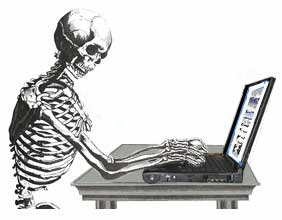
[podcast]http://edwardwillett.com/wp-content/uploads//2012/01/Losing-Weight-Through-Writing.mp3[/podcast] One of the risks of being a writer is a tendency to fall into sedentarianism (which isn’t a word, but ought to be; clearly, it refers to a religious belief that the best way to avoid sin is to do as little as possible). Aside from those keeners who have set up combination desks/treadmills …
Tag: exercise

Stretching: the truth
[podcast]http://edwardwillett.com/wp-content/upLoads//2011/03/Stretching-the-Truth.mp3[/podcast] Exercise is good for you. It’s a shame, since I personally find the whole sweating/breathing hard/ hurting thing a (literal) pain, but I don’t believe I can mount a successful argument as to why sitting on your rear end eating junk food all day is actually better for you, even though evolution seems to …
Stop that stretching!
[podcast]http://edwardwillett.com/wp-content/upLoads//2009/07/Stretching.mp3[/podcast] There’s a perception that science is always reversing itself. If you don’t like what science has to say about, say, the health benefits or risks of a particular food (eggs, for example, or coffee), you only have to wait awhile until a contradictory study comes out. That’s because science progresses in fits and starts. …
Bicycles II
It’s summertime in Saskatchewan, and that means the roads are full of joggers, walkers–and bicyclists. The first bicycle was the “celerifere,” or wooden horse, invented in France in the 1790s. It had a fixed front wheel, so it couldn’t be steered, and the rider propelled it by pushing his feet along the ground, like Fred …
Bicycles
I wouldn’t call myself a “serious” cyclist, since I don’t wear neon Spandex shorts and top, a colour-coordinated helmet, leather gloves or fancy cycling shoes. Heck, I don’t even have a water-bottle. But I do cycle a bit, and as I was puffing my way along the bike path the other day it seemed to …
Exercise
I hate exercise. It’s uncomfortable, sweaty, and cuts into quality TV time. Unfortunately, it’s good for you. Exercise is physical exertion for the purpose of improving physical fitness. (If it’s for any other purpose, we call it “hard work.”) Modern fitness programs got their start in Prussia in the 1800s (which should tell you something). …
My latest live walk and vlog

Buy Autographed Books