


I spent a good chunk of today at Wordbridge, the annual writers’ conference in Lethbridge, Alberta. My main reason for coming was to launch a Shadowpaw Press title (Broken Realm by Jenna Greene, a Lethbridge author), but I also conducted one of my popular Seven-Sentence Short Story workshops (for which I take no credit: it was created by science fiction and fantasy author James van Pelt).
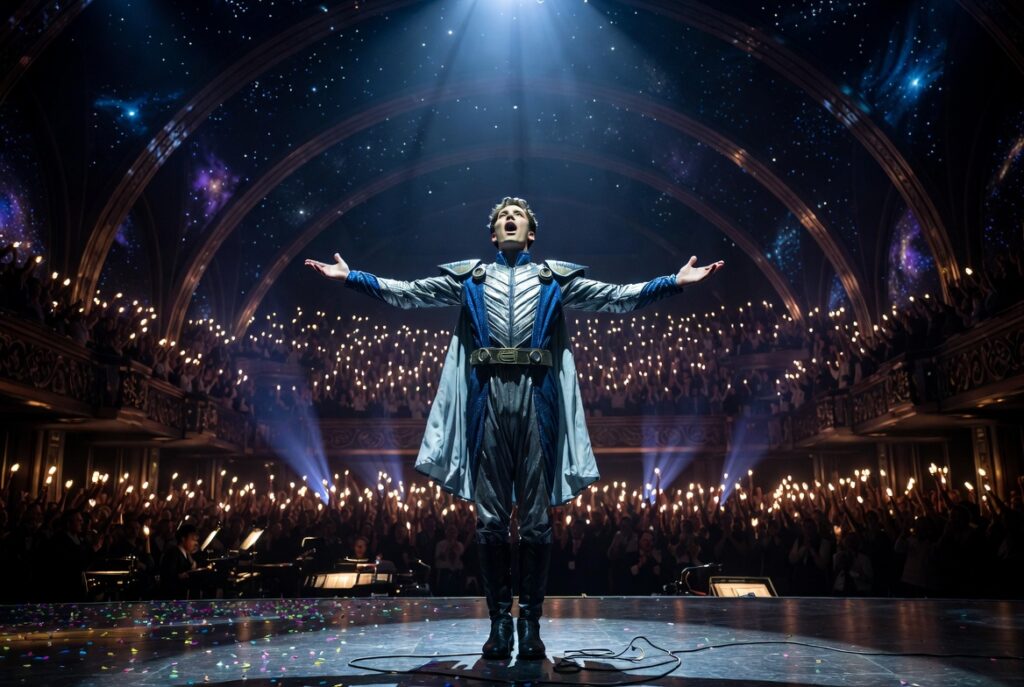
Herewith (with illustration by Grok) is “He Came, He Fell, He Conquered”:
Introduce what the main character wants and the first action he/she takes to accomplish that goal.
As the cue came, “Behold, he comes!” Anthony took a deep breath and stepped onto the stage of the Parador Theatre, the great hall named after his legendary grandfather, ready at last to sing the song that he was certain would propel him to musical theatre fame and fortune not only on Earth but on all of its colonies scattered among the stars.
The results of the action the character takes in sentence #1 has to make the situation worse. The character should be further from the goal now.
Whether it was malicious or by accident, he never knew, but the power cord left untaped by a stagehand, hidden in the darkness behind the curtain, seized his foot as though it were an enemy hidden beneath the surface of the stage, sending him stumbling forward, overbalanced, arms flailing, desperately trying to regain his balance before he fell flat on his face, an effort that provided great amusement to the crowd, as witnessed by their gales of laughter, bur failed utterly in its intended purpose, since it ended with a thud as he hit the stage as heavily as though he were a sandbag dropped from the flies.
Based on the new situation, the character takes a second action to accomplish the goal.
Anthony had not rehearsed, and studied, and worked his way up from school performances to community theatre to regional theatre to now, at last, the theatrical pinnacle of Earth, and therefore the theatrical pinnacle of all the known worlds, to let a little thing like a face plant stop him; and so he took a new, even more determined and thus even deeper deep breath and prepared to launch himself to his feet in time to begin singing at the appropriate place in the song, which was rapidly approaching since the pit orchestra had no idea what had just happened out of their sight on the stage and would not have stopped even if they had, musicians being what they were.
The result of the second action the character takes, from sentence #3, is to make the situation worse. The character should be even further from the goal now.
Perhaps the same stagehand who had failed to tape down the power cord had also failed to properly sweep the stage, because when Anthony took that second and even deeper deep breath, still almost face down, he breathed in, not only a quantity of air, but also a tiny piece of confetti, a harmless fleck left over from the snowstorm that had concluded the end of the first act (in which Anthony had not appeared, his role being that of a man everyone else talked about arriving who took his own sweet time about doing so), and thus, when the moment in the accompaniment came when he was supposed to erupt in glorious song, he instead erupted in a fit of coughing, a fit amplified by the microphone he wore so that it assaulted the ears of the crowd—a massive crowd, for the theatre was huge and was packed to the rafters for this much-anticipated premiere of The Spaceman’s Concubine—like an artillery barrage, and the laughter of a moment before was instead replaced by a shocked and appalled silence.
Based on the new situation, the character takes a third and final action to accomplish the goal.
The coughing was so thunderous, and the silence that followed so eerie, that the pit orchestra finally realized something had happened; and it was then, as they themselves fell silent in a final, undignified chorus of squawks, that Anthony saw his chance—or, perhaps, as he would say in later years, it was then that the ghost of his grandfather, who had trod these boards so many years ago, so memorably they had renamed the hall after him, whispered to him—and, leaping to his feet, he spread his arms wide and launched his voice into the deathly silence, a cappella, nothing beneath it but silence, nothing above it but the vaulted ceiling of the theatre.
The third action either accomplishes the character’s goal, fails to accomplish the goal, or there is an unusual but oddly satisfying different result of the last action.
There was no possibility of the orchestra joining in, and so he sang the entire song unaccompanied, the great love song of the musical, how he, the titular spaceman of The Spaceman’s Concubine, had finally returned from his long sojourn among the stars only to find that his lover had, in his absence, herself left Earth to search for him, and how that discovery had left him heartbroken and alone but determined, in his turn, to return to the stars to seek her out; and when he sang the last note, high, tremulous, filled with longing and determination, and then let it die away, the silence into which he had begun the song, following the disaster of his entrance, held a moment longer, then two: and then, the crowd leaped to its feet as one in a spontaneous explosion of applause and cheering that went on and on while Anthony simply stood in his final pose, staring up at the stars, without acknowledging it, cementing his character and ensuring that that, not what had happened when he entered, would remain in the audience’s memories afterward.
The denouement. This sentence wraps up the story. It could tell the reader how the character felt about the results, or provide a moral, or tell how the character’s life continued on.
In later years, that moment became part of the legend: the legend of Anthony Parador, the greatest musical theatre performer of his age, who turned disaster into triumph and launched a career that would see him perform on every world on which humanity had established a foothold, a career that spanned decades and may still be going on somewhere—for Anthony, of course, was abducted by aliens during his final farewell tour, and the cryptic message they left behind, “Now he is ours and he will continue” was the last anyone ever heard of him.