
In the movies, spaceships have artificial gravity, because it’s a heck of a lot easier to film that way. Real-life astronauts aren’t so lucky. The men and women who inhabit the Mir space station spend months in weightlessness. Sure, it’s a lot of fun–flying around, leaving objects hanging in mid-air–but inside those cosmonauts’ and astronauts’ …
Tag: science
Airships (1999)
It’s one of the most familiar newsclips of the 20th century: the giant airship Hindenburg approaching the mooring mast in New Jersey, the sudden rush of fire, the announcer choking out “the humanity, the humanity!” as the Hindenburg settles to the ground in flames. Many people think giant, passenger-carrying airships died forever with that crash. …
Bouncing balls
Summer is high sports season, and most of the games being played involve balls: baseballs, tennis balls, volleyballs, soccer balls. At first glance, every ball appears much the same as every other ball: round and bouncy. The only thing that’s different is the size. But in fact, each ball is designed specifically for the sport …
Con-Version XVI
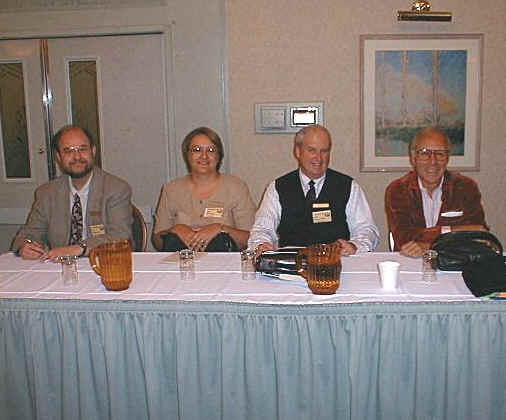
A couple of weeks ago my wife and I had the pleasure of once again attending ConVersion, the annual science fiction convention held in Calgary. Now, I know what you’re thinking. You’re picturing a bunch of oddballs in Star Trek and Star Wars costumes, sitting in the dark watching videos and yelling out the dialog in time with …
Lake monsters
Now that summer is winding down and people are heading home from the lake, it’s time to ask, “Did you see anything weird out there?” It wouldn’t be surprising if you did, since Canada has more lake monsters than any other country in the world. “Lake monsters” are large unknown creatures said to inhabit many …
Lightning and humans
Being struck by lightning is one of those occurrences we consider highly unlikely. How often have you said, “You’re more likely to be struck by lightning than… (fill in the blank–win the lottery, for example). But for a surprising number of people every year, the unlikely becomes all too real. The National Weather Service in …
Internal clocks
Once in a while, everyone has trouble getting to sleep. (I rarely do, but that’s because, now that I’m married, I have to get up much earlier than I did in my single days, in order to get my wife off to work. Marriage as a cure for sleeplessness might seem a little drastic to …
Einstein’s brain
Albert Einstein, the 20th century’s best-known scientist, revolutionized the way we think about the universe. This week, he was back in the news–or at least, part of him was. When Einstein died on April 17, 1955, he left his wishes that an acquaintance perform the autopsy and his body then be cremated. The acquaintance didn’t …
Pyramids
The Great Pyramid at Giza recently reopened after a year of restoration, allowing visitors to Egypt to once again see where King Khufu was entombed more than 4,500 years ago. The Great Pyramid is an astonishing human achievement, on a scale that impresses even now, in the age of Superdomes and skyscrapers. Originally 145.5 metres …
Mummies
Half a century after Boris Karloff first played the man in the bandages, The Mummy is once again drawing people in droves to movie theatres. It’s almost like The Mummy has eternal life–which, of course, is the whole idea. A mummy is any dead animal or human body in which soft tissues have been preserved …
Liberty Bell 7
On July 21, 1961, Virgil Ivan “Gus” Grissom, 33, a decorated fighter pilot, was strapped into the tiny Mercury space capsule he’d nicknamed Liberty Bell 7 and launched into space aboard a Redstone rocket. The U.S.’s first manned spaceflight, Alan Shepard 15-minute sub-orbital flight, had occurred just 2 1/2 months before. Grissom’s mission was nearly …
My latest live walk and vlog

Buy Autographed Books