
[podcast]https://edwardwillett.com/wp-content/uploads//2012/12/Circadian-Deosynchrony-and-the-Blue-Light-Special.mp3[/podcast] We’re coming up on the shortest day of the year in the northern hemisphere: at the latitude I live at, in Regina, Saskatchewan, that means that today the sun rose at 8:49 a.m. and will set at 4:54 p.m. We’ll lose a few more minutes yet before the winter solstice. That’s not a lot …
Tag: health

The case for coffee consumption
[podcast]https://edwardwillett.com/wp-content/uploads//2012/12/The-Case-for-Coffee-Consumption_01.mp3[/podcast]I first wrote about coffee in a science column back in the dawn of time, so long ago that it began, “Let’s get one thing straight. I don’t drink coffee…” Since as I type this I am on my second…or maybe third… good-sized cup (oh, all right, mug) of the stuff, something has clearly changed …

Pop! goes nutrition
[podcast]https://edwardwillett.com/wp-content/uploads//2012/03/Popcorn-Nutrition.mp3[/podcast] There’s nothing quite like the smell of popcorn. It makes you think of movie theatres, the circus, the midway. It makes you long for a handful. Or two. Or better yet, a whole bucket. And best of all, just this week some research results were released that indicate popcorn is also a very healthy …

Of mice and man-flu
[podcast]https://edwardwillett.com/wp-content/uploads//2011/10/Of-Mice-and-Man-Flu.mp3[/podcast] As any wife will tell you, men are lousy at being sick. They swear they’re on death’s door when it is quite apparent to their long-suffering significant other that in fact they are suffering from nothing more than a cold, nowhere near as bad as the one she had the week before when she …

Stretching: the truth
[podcast]https://edwardwillett.com/wp-content/upLoads//2011/03/Stretching-the-Truth.mp3[/podcast] Exercise is good for you. It’s a shame, since I personally find the whole sweating/breathing hard/ hurting thing a (literal) pain, but I don’t believe I can mount a successful argument as to why sitting on your rear end eating junk food all day is actually better for you, even though evolution seems to …

Confessions of a cyberchondriac
A few years ago I wrote several children’s books for the Diseases and People series put out by Enslow Publishers. It’s amazing when you’re writing about disease how easy it is to convince yourself you’ve got the symptoms of whatever you’re writing about. The first book was Meningitis. Stiff neck? You bet. Of course, I …
It’s past your bedtime!
[podcast]https://edwardwillett.com/wp-content/upLoads//2011/01/Its-Past-Your-Bedtime.mp3[/podcast] Ah, New Year’s. A time for resolutions, typically focused on living more healthily. Apparently the Canadian Broadcasting Corporation, not trusting us to do it ourselves, has decided to make our resolutions for us: it’s started 2011 with a series of stories lecturing Canadians on how unhealthy their lifestyle is, and started something called the …
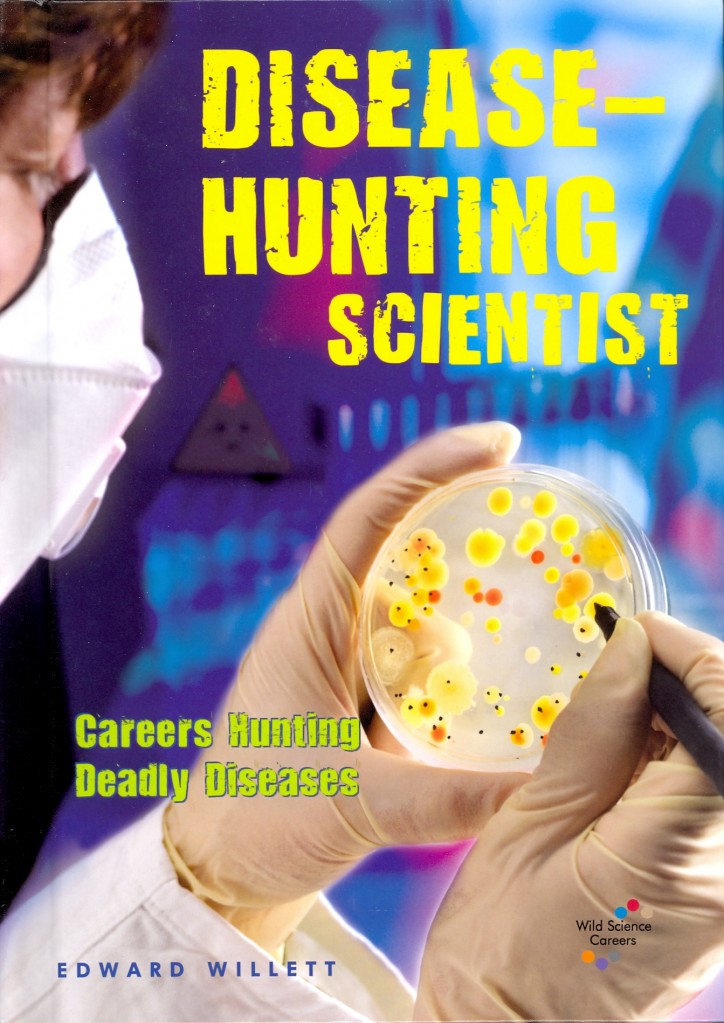
I get a box full of disease detectives!
Oh, all right, not the actual detectives themselves, but my latest book from Enslow, Disease-Hunting Scientist: Careers Hunting Deadly Disease. That’s the cover at left. Here’s the blurb from the back: Working from high-tech labs in Canada or remote villages in Africa, epedemiologists travel the world trying to keep us safe from deadly diseases. Learn how …
Stop that stretching!
[podcast]https://edwardwillett.com/wp-content/upLoads//2009/07/Stretching.mp3[/podcast] There’s a perception that science is always reversing itself. If you don’t like what science has to say about, say, the health benefits or risks of a particular food (eggs, for example, or coffee), you only have to wait awhile until a contradictory study comes out. That’s because science progresses in fits and starts. …
Are cognitive shortcuts making us fat?
[podcast]https://edwardwillett.com/wp-content/upLoads//2009/06/Cognitive-Shortcuts-to-Obesity.mp3[/podcast] When we think about how we make decisions, we tend to imagine that we consider the facts of a situation carefully and logically, in a straightforward, step-by-step manner. But that process is, indeed, imaginary. The truth is that our brains prefer to do as little actual thinking as possible. They like shortcuts—and sometimes those …
Disease-Hunting Scientist: Marta Guerra and Ebola
[podcast]https://edwardwillett.com/wp-content/upLoads//2009/06/marta-guerra-and-ebola.mp3[/podcast] Here’s one last column condensed from a chapter in my new children’s book Disease-Hunting Scientist: Careers Hunting Deadly Diseases (Enslow Publishers): In the movie Outbreak, researchers from the U.S. Army Medical Research Institute for Infectious Diseases and the Centers for Disease Control and Prevention (CDC) have to figure out how to stop a kind …
An instantaneous, universal, programmable vaccine?
[podcast]https://edwardwillett.com/wp-content/uploads/2009/03/a-universal-instant-vaccine.mp3[/podcast] Efforts to immunize people against disease go back to at least 600 B.C., when the Chinese attempted to immunize people against smallpox by putting smallpox material in their nostrils (the permitting of which, I would think, would require a great deal of faith in your doctor). Modern immunization began in 1796 when a British …
My latest live walk and vlog

Buy Autographed Books
Most Recent Episodes
-
Episode 165: Dr. Katherine Hutchinson-Hayes – A Fifth of the Story
 A chat with author, podcaster, and blogger Dr. Katherine Hutchinson-Hayes about her new spy thriller, A Fifth of the Story Websitedrkatherinehayes.com Facebook@authordrkatherinehayes Instagram@authordrkatherine X@khutch0767 Dr. Katherine Huthcinson-Hayes’s Amazon Page Amazon Links for A Fifth of the StoryAmazon.comAmazon.ca About the Book A fascinating thriller of espionage that takes you into the secretive world of the CIA…
 -
Episode 164: Kristen Ciccarelli – Heartless Hunter
A chat with New York Times bestselling YA author Kristen Cicarelli about Heartless Hunter, The Crimson Moth Book 1, a “dangerously romantic Scarlet Pimpernel-inspired fantasy.” Websitekristenciccarelli.com Facebook@AuthorKristenCiccarelli Instagram@kristenciccarelli Pinterest@kciccarelli Kristen Ciccarelli’s Amazon Page Amazon Links for Heartless HunterAmazon.comAmazon.ca About the Book Enemies-to-lovers doesn’t get more high stakes than a witch and a witch hunter falling… -
Episode 163: Sebastien de Castell – Play of Shadows
A chat with award-winning fantasy author Sebastien de Castell about Play of Shadows, Book 1 of Court of Shadows, set in the world of his popular Greatcoats series. Websitedecastell.com X@decastell Facebook@decastell Sebastien de Castell’s Amazon Page Amazon Links for Play of ShadowsAmazon.comAmazon.ca About the Book Swordplay, magic, intrigue and friendships stronger than iron: the first… -
Episode 162: Lyn McGinnis – Amarel Mountain
A chat with author Lyn McGinnis about Anu Awakes, an epic fantasy series, and the most recent release in that series, Book 2, Amarel Mountain. Websiteanuawakesseries.com Bluesky@anuawakes Goodreads Instagram@anuawakes Lyn McGinnis’s Amazon Page Amazon Links for Amarel MountainAmazon.comAmazon.ca About the Book Descendants of the Tolku of the Primary Epoch, the Koru, Yakku and Yelda, now… -
Episode 161: Jared N. Michaud – Brightstar
A chat with new author Jared N. Michaud about his upcoming YA science fiction novel Brightstar, first book in the Energematric6 space adventure series. Websiteenergematrice6.com Facebook@Energematrice6 X@Energematrice6 Instagram@jarednmichaud Jared N. Michaud’s Amazon Page Amazon Links for BrightstarAmazon.comAmazon.ca About the Book Brightstar is the beginning of an epic space-adventure series that introduces readers to Nate, a… -
Episode 160: Breakfield & Burkey – Enigma Tracer
A chat with the writing team of Charles Breakfield and Rox Burkey about their long-running techno-thriller series, Enigma, and Enigma Tracer, first book in their new Enigma Heirs trilogy. Websiteenigmabookseries.com Facebook@TheEnigmaSeries X@EnigmaSeries@1rburkey Instagram@enigmabookseries YouTube Amazon Links for Engima TracerAmazon.comAmazon.ca About the Book The clock is ticking … can Gracie uncover the truth? Phillip Pliant is… -
Episode 159: Steve Truitt – The Mindset Chronicles
A chat with author and former television host Steve Truitt about his new science fiction novel series, The Mindset Chronicles. Websitestevetruitt.com Facebook@AuthorSteveTruitt Amazon Links for The DeletionAmazon.comAmazon.ca Steve Truitt’s Amazon Page About the Book In a world where artificial intelligence has become an integral part of daily life, the sudden death of all AI sends… -
Episode 158: Danièle Cybulskie – Chivalry and Courtesy: Medieval Manners for a Modern World
A chat with noted medievalist Danièle Cybulskie about her new book, Chivalry and Courtesy: Medieval Manners for a Modern World. Websitedanielecybulskie.com X/Twitter@5minmedievalist Facebook@5MinMedievalist Instagram@5minmedievalist YouTube@5MinMedievalist Amazon Links for Chivalry and CourtesyAmazon.caAmazon.com Danièle Cybulskie’s Amazon Page About the Book Medieval people are often portrayed as having poor hygiene and table manners—licking their knives or throwing chicken… -
Episode 157: Marie Brennan – The Market of 100 Fortunes (Legend of the Five Rings Book 3)
A chat with Hugo-nominated author Marie Brennan about her Legend of the Five Rings trilogy, which just wrapped up with The Market of 100 Fortunes. Websiteswantower.com Bluesky Patreon Amazon Links for The Market of 100 FortunesAmazon.caAmazon.com Marie Brennan’s Amazon Page About the Book Enthralling fantasy mystery from the world of Legend of the Five Rings as two… -
Episode 156: Douglas Smith – The Lost Expedition (The Dream Rider Saga, Book 3)
A chat with Canadian author Douglas Smith about his young adult fantasy trilogy The Dream Rider Saga, which has just culminated in Book 3, The Lost Expedition. Websitesmithwriter.com Facebook@WritingtheFantastic X/Twitter@smithwritr Instagram@douglassmithwriter Amazon Links for The Lost ExpeditionAmazon.caAmazon.com Douglas Smith’s Amazon Page About the Book The Thrilling Conclusion to the Multi-Award-Winning Trilogy Will is the Dream…