Here’s my latest Space-Time Continuum column from the January 2023 issue of the Saskatchewan Writers’ Guild’s magazine, Freelance. “When I use a word,” Humpty Dumpty said in rather a scornful tone, “it means just what I choose it to mean — neither more nor less.” —Lewis Carroll, Through the Looking Glass Humpty Dumpty, noted wall-sitter and …
Category: Columns
The Space-Time Continuum: Make Our Garden Grow
This is the latest in my occasional column about writing science fiction and fantasy that appears in the Saskatchewan Writers Guild magazine Freelance. Authors who are regularly interviewed often profess to hate one particular question, the cliché of clichés: “Where do you get your ideas?” (One oft-quoted response to this question is that given by …
The Space-Time Continuum: Why do we write?
This is my latest “Space-Time Continuum” column for the Saskatchewan Writers Guild‘s news magazine Freelance. Have you ever asked yourself why you write? Or asked your writer friends why they write? I have. In fact, I literallyasked myself that question in one episode of my ongoing podcast, The Worldshapers (www.theworldshapers.com), featuring conversations with science fiction and fantasy …
The Space-Time Continuum: Pros talk about rewriting prose
Here’s my latest “Space-Time Continuum” column from the Saskatchewan Writers’ Guild‘s newsletter Freelance… When I talk about writing (which I do, rather a lot), I’ll often say something like, “the most important part of writing is rewriting.” And I believe that’s true…but what rewriting means to an individual author varies. I’ve recently started a podcast, The …

The Space-Time Continuum: How a small-town Saskatchewan boy launched science fiction’s Golden Age
My most recent Space-Time Continuum column for Freelance, the magazine of the Saskatchewan Writers’ Guild. The Golden Age of science fiction, many say, began with the publication of A.E. van Vogt’s story “Black Destroyer” in Astounding in 1939. Isaac Asimov’s first story for Astounding appears in that same issue; the next contained the first story by Robert …
The Space-Time Continuum: Steam-Engine Time
Here’s my latest column from Freelance, the magazine of the Saskatchewan Writers Guild. All forms of art, from the visual to the theatrical, from motion pictures to literature, tend to go through movements. One reason for this is simply copycatting, something that is most clearly seen in the motion picture industry: somebody makes a movie …
The Space-Time Continuum: What do writers owe their readers?
Here’s my latest column from Freelance, the magazine of the Saskatchewan Writers Guild. The Winds of Winter, the sixth book in George R.R. Martin’s bestselling fantasy series A Song of Ice and Fire, still doesn’t have a release date, six years after the release of A Dance with Dragons. (And there’s a final book, A …
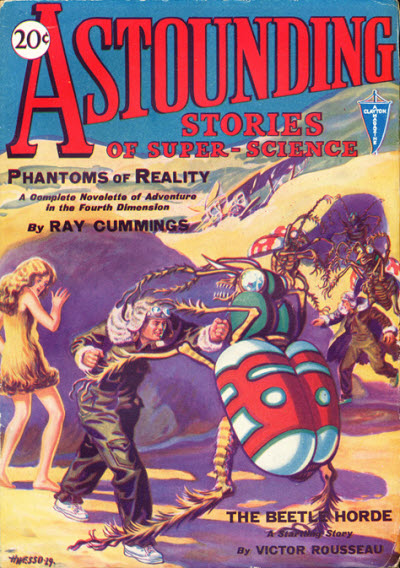
The Space-Time Continuum: Pulp Fiction
This is my latest column from the Saskatchewan Writers Guild magazine Freelance, with extra graphics! Mention “pulp fiction” these days and most people probably think of the 1994 Quentin Tarantino movie. But of course the movie’s title referenced something much earlier: fiction literally published on pulp—cheap paper made directly from wood-pulp. Pulp paper quickly turns …
The Space-Time Continuum: What’s the Big Idea?
Here’s my latest “Space-Time Continuum” column from the Saskatchewan Writers Guild‘s magazine Freelance. “Where do you get your ideas?” is a question every author has heard multiple times. I usually say something about how story ideas are all around us, and give some examples. But recently I’ve realized there are two different kinds of ideas …
The Space-Time Continuum: Aliens in Science Fiction
Having just posted my column from the February/March 2017 issue of Freelance, the magazine of the Saskatchewan Writers Guild (see previous post), it behooves me to be more timely and post the most recent column, from the April/May issue. And here it is! I remember being confused, as a kid, the first time I encountered the …
The Space-Time Continuum: Creating Magic Systems
This is a belated posting of my column from the February-March 2017 issue of Freelance, the magazine of the Saskatchewan Writers Guild. Don’t know how I missed posting it, but better late than never! Most fantasy stories include magic: that’s kind of what makes them fantasy. (In fact, if I had to distinguish between fantasy …
The Space-Time Continuum: Maxims and proverbs and saws, oh my!
Here’s my latest Space-Time Continuum column for Freelance, the magazine of the Saskatchewan Writers Guild: Writers love to write about writing, probably because writing about writing is a great way to avoid actually, you know, writing. Sometimes writing about writing takes the form of a long essay or (ahem) column; sometimes it takes the form …
My latest live walk and vlog

Buy Autographed Books